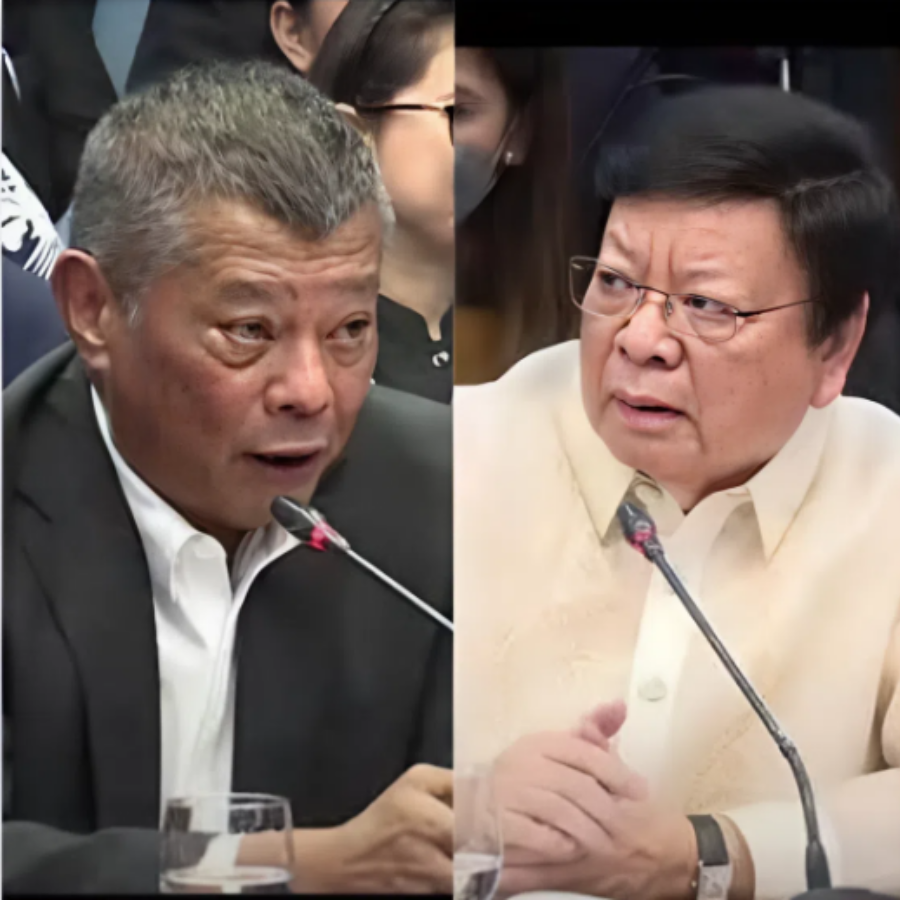
🔥 LEGAL EARTHQUAKE IN THE PHILIPPINES: SENATOR MARCOLETA’S DISBARMENT THREAT AGAINST DOJ SECRETARY REMULLA BACKFIRES AS BAR PRESIDENT DELIVERS STINGING REBUKE 🔥
In a nation where politics and law often collide in spectacular fashion, a single Senate hearing has ignited a storm that has captured the attention of the entire Philippines. What began as a technical discussion over the administration of the Witness Protection Program has spiraled into a national debate on legal ethics, morality, and the interpretation of law—pitting two of the country’s most prominent figures against each other: Senator Rodante Marcoleta, known for his unwavering stance and sharp questioning, and Department of Justice Secretary Crispin Remulla, a legal mind navigating the intricate maze of Philippine jurisprudence.
The confrontation turned explosive when Marcoleta, frustrated by Remulla’s insistence on restitution for ill-gotten wealth as a condition for state witness eligibility, issued an unanticipated threat: the Justice Secretary could face disbarment for overstepping his authority. The statement sent shockwaves through the chamber and ignited immediate debate across legal and political circles.
The tension stems from Remulla’s assertion that while the law does not explicitly require a prospective state witness to return stolen assets before entering the Witness Protection Program, doing so is a moral and ethical obligation. “It is not just a legal matter; it’s what is morally right,” Remulla said emphatically during the Senate hearing, underscoring his belief that public trust and accountability extend beyond mere statutory interpretation. For Remulla, allowing individuals who have siphoned public funds to retain their ill-gotten wealth while seeking protection undermines both the justice system and societal morality.
Senator Marcoleta, however, interpreted Remulla’s remarks as a dangerous expansion of authority. He argued that the law is clear: restitution cannot be demanded prior to legal adjudication of guilt, and that preconditions of this nature fall outside the Secretary’s mandate. “You do not change the provision of law, Mr. Secretary,” Marcoleta thundered, culminating in his dramatic threat of disbarment—a declaration that left observers stunned at the unprecedented confrontation between a legislator and the head of the nation’s justice department.
The fallout was swift. The public spectacle of a senator threatening the country’s chief law officer prompted a reaction from the legal community, led by Attorney Alan Panoñgon, President of the Integrated Bar of the Philippines (IBP). Panoñgon’s intervention would prove decisive. Through careful analysis, he dismantled Marcoleta’s literalist reading of the law, situating Remulla’s position within both statutory mandates and foundational civil principles.
Citing Section 5 of Republic Act 6981, Panoñgon explained that eligibility for witness protection explicitly requires compliance with “legal obligations and civil judgments against [the applicant].” This includes restitution where applicable. He noted that a Memorandum of Agreement is executed upon qualification as a state witness, wherein such legal obligations are formalized. In effect, a witness’s willingness to return ill-gotten funds demonstrates sincerity, good faith, and adherence to civil responsibilities—exactly the position Remulla advocated.
Beyond the letter of the law, Panoñgon highlighted the principle of unjust enrichment, codified in Articles 22 and 23 of the Civil Code, which prohibits profiting at the expense of another without legal justification. Anyone who retains money or benefits derived from illegal activities, particularly public corruption, is legally and morally obliged to return them. By applying these principles, Panoñgon argued, Remulla’s insistence on restitution was not an overreach but an application of the law’s intent and spirit.
Other legal experts echoed this view. Attorney Joseph Noel Strada stressed that sincerity is a cornerstone for the effective implementation of the Witness Protection Program. Without demonstrating good faith through restitution, prospective witnesses could exploit the system as a shield against accountability while retaining illicit gains. “Justice is not only about following the letter of the law but also ensuring fairness and integrity,” Strada remarked.
The intervention of Panoñgon and other legal authorities shifted public perception dramatically. Marcoleta, who once wielded the threat of disbarment as a powerful instrument against Remulla, suddenly found himself under intense scrutiny. His rigid adherence to literal statutory interpretation contrasted sharply with the broader principles of justice emphasized by the IBP, highlighting a tension between legal formalism and ethical governance.
The debate has since transcended the initial dispute over witness restitution. It has evolved into a national discussion on the very nature of justice, accountability, and morality in Philippine governance. Citizens and legal scholars alike are now questioning whether laws should be interpreted purely in their literal form or with consideration of broader ethical obligations that uphold public trust. The episode has forced lawmakers, legal practitioners, and the general public to confront uncomfortable questions: What does it mean to administer justice fairly? How much discretion should public officials exercise when interpreting statutes? And when is moral responsibility inseparable from legal authority?
For now, the repercussions for Marcoleta remain uncertain. While no formal disbarment proceedings have been initiated, his credibility has been challenged by the highest legal authorities in the country. Meanwhile, Secretary Remulla’s stance has been vindicated, with the IBP’s authoritative explanation lending weight to his insistence on integrity and restitution.
This dramatic confrontation serves as a stark reminder of the complex interplay between law, ethics, and public duty. In a country grappling with corruption, inequality, and a demand for accountable governance, the clash between Marcoleta and Remulla underscores a fundamental principle: true justice extends beyond the narrow confines of written statutes, embracing moral responsibility, civic trust, and the ethical obligations of those who hold power.
As the nation watches closely, this legal earthquake continues to reverberate across the Philippines—reshaping perceptions, prompting debate, and reminding all that the pursuit of justice is as much about integrity as it is about law.