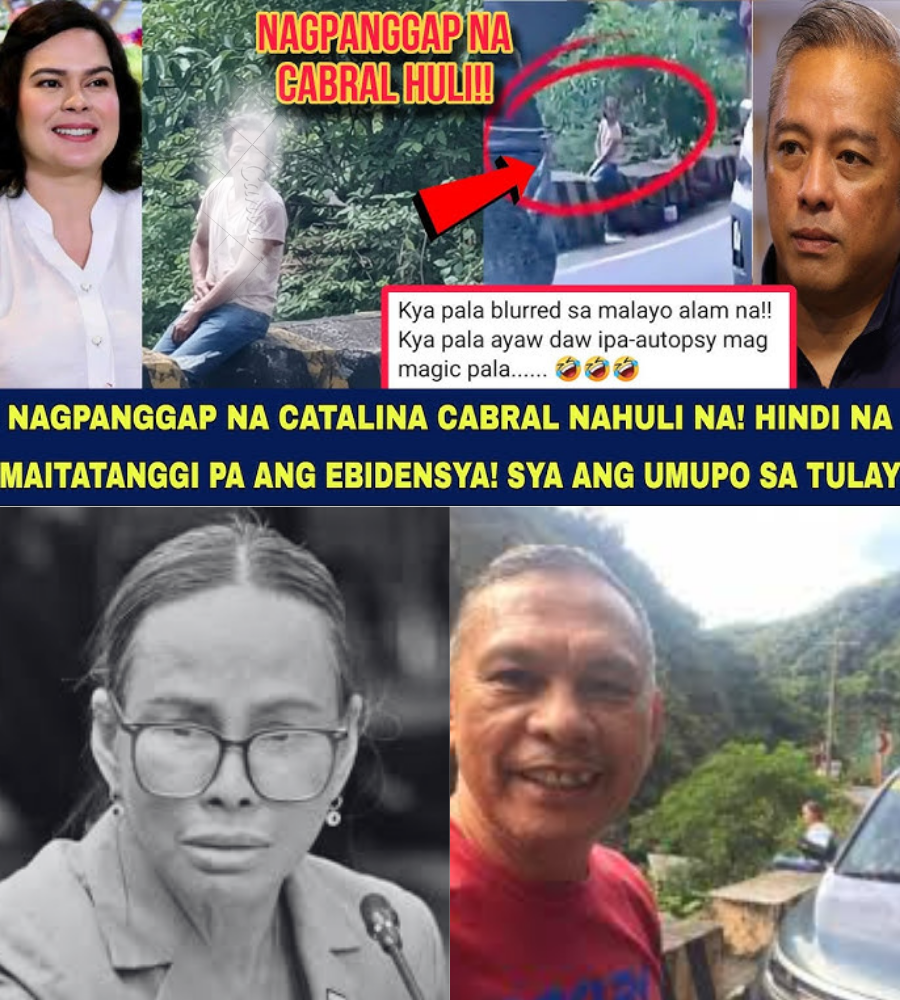
Maria Catalina Cabral—did she voluntarily walk to the edge of the abyss, or was she placed there to be silenced forever? A woman known for her fear of heights—why was she seen sitting on a bridge spanning a deep ravine, the very place where she was believed to have fallen to her death? With her phone left behind, fractured timelines, and unusual intervention by high-ranking officials, a chilling question remains: was this an accident—or a carefully staged silence?
“How does a woman known to fear heights end up at the edge of a ravine—without her phone, without her bag, and without a single witness to explain why?”
When news broke that former DPWH undersecretary Maria Catalina “Kathy” Cabral was found lifeless at the bottom of a steep ravine along Kennon Road, the story immediately unsettled the public. Not because tragic falls are unheard of—but because almost every detail surrounding her final hours seemed to contradict logic, habit, and basic human instinct.
Cabral was widely known among colleagues as someone who feared heights. Friends described her as cautious, methodical, and acutely aware of risk. Yet she was discovered in one of the most treacherous cliffside areas in Benguet—an isolated stretch of road where a single misstep can mean death. The question that refuses to fade is simple yet haunting: Why would she choose that place at all?
Even more troubling was what she left behind.
Her phone.
Her bag.
Her personal valuables.
All were found inside her parked vehicle.
Anyone venturing into a remote cliffside location would normally carry basic tools for safety and communication. Leaving them behind stripped Cabral of control and connection, raising the first wave of doubt. Was it a momentary lapse? A stress-induced decision? Or was there an unseen influence that altered her judgment?
Then came the time gap.
Several hours passed between the moment she reportedly left her vehicle and the discovery of her body. No witnesses came forward. No distress signals were sent. No calls, no messages, no digital trace explaining her movements. As investigators dug deeper, the mystery only thickened.
Psychologists note that the case presents a disturbing clash of opposites:
Fear versus action.
Risk awareness versus exposure.
Rational behavior versus fatal consequence.
Multiple theories emerged. She may have sought solitude. She may have become disoriented. She may have suffered a sudden medical episode. Or—most unsettling of all—she may not have been entirely alone in her final moments.
While the autopsy confirmed blunt force trauma consistent with a fall, it failed to resolve the behavioral contradictions that keep the case in the public spotlight. Cabral’s final hours remain a puzzle of psychology, circumstance, and power—a reminder that even the most careful individuals can end up in situations that defy reason.
But the questions did not stop at the ravine.

The Directive That Raised Alarms
What truly ignited suspicion was what happened after Cabral was found.
Almost immediately, Ombudsman Jesus Crispin Remulla reportedly issued a directive to police authorities in Benguet to secure and preserve Cabral’s gadgets, treating them as critical items of interest. This move raised eyebrows among legal experts and observers.
Why?
Because the Office of the Ombudsman does not conduct police investigations—whether a case involves a crime or an accident. Its constitutional mandate is to investigate graft-related offenses and, if warranted, file cases before the Sandiganbayan. Crime scene control and evidence preservation fall squarely under police jurisdiction, not the Ombudsman’s.
So why the sudden, urgent interest in Cabral’s phone?
Speculation quickly surfaced that her device might contain sensitive digital files—possibly including documents identifying proponents linked to flood control projects under the 2025 General Appropriations Act. If true, the implications would be enormous.
Yet even if the Ombudsman believed Cabral’s phone contained incriminating material, legal scholars argue the directive was procedurally improper. More puzzling still, the Ombudsman’s brother—Interior Secretary Jonvic Remulla—already had authority over the police. A simple coordination within the executive branch would have sufficed.
Instead, what followed appeared to many as an overreach.
The Fallout in Benguet
When it was later revealed that the directive regarding Cabral’s gadgets was not followed “to the letter,” Interior Secretary Remulla ordered the relief of the Benguet provincial police director and the Tuba municipal chief of police.
This decision stunned many within law enforcement.
On the night of the incident, the prevailing narrative was clear: Cabral had fallen. Local police treated it as an accident. Emergency responders acted according to training—prioritizing rescue and medical intervention over crime scene preservation. At that moment, there was no indication of foul play.
No suspicious wounds.
No witness accounts suggesting a crime.
No immediate evidence pointing to homicide.
From a policing standpoint, there was no basis to cordon off the area with yellow tape or treat it as a crime scene. To punish officers retroactively for not anticipating a different narrative struck many as unfair—and excessive.
Critics labeled it an overreaction, especially when combined with the earlier interest in Cabral’s personal devices. Together, these actions fueled a growing suspicion that something far more sensitive than an accidental fall was at stake.
And Then, the Final Twist
In a development that only deepened the intrigue, authorities later confirmed that there was nothing to recover from Cabral’s body. Her smartphone was never with her at the ravine. It had been left inside her vehicle and was promptly turned over to her family.
The object that seemed to trigger such urgency… was never at the scene.
This revelation left observers asking:
If the phone was not at risk of being lost, destroyed, or tampered with—why the extraordinary response?
Why the directives outside jurisdiction?
Why the swift removal of police officials who followed protocol?
Why the urgency that seemed disproportionate to the facts known at the time?
Accident or Something More?
To this day, Cabral’s death sits uncomfortably between two explanations.
On one side: a tragic accident shaped by stress, isolation, and human vulnerability.
On the other: a sequence of actions by powerful institutions that suggests fear—not of death, but of information.
Until investigators can fully reconstruct her final movements, clarify the legal oversteps, and explain the extraordinary interest in her digital trail, the case will remain unresolved in the public mind.
In the end, one question continues to hover—quietly, ominously—over Kennon Road:
How does a woman who feared heights end up falling in a place seemingly designed to test that fear… and why did so many powerful figures move so quickly afterward, not toward the ravine—but toward her gadgets?