JUSTICE HAS A NAME—KIAN’: Supreme Court Delivers Its Final Blow, Sentencing Three Police Officers to Life in Prison for a Brutal Execution That Exposed Abuse of Power, Shattered Public Trust, and Redefined Accountability Under the Law”
Eight years after a single night of terror that ended the life of a 17-year-old student, the Philippine Supreme Court has issued a final, ironclad ruling that closes one of the most painful chapters in modern Philippine justice—and opens a powerful reckoning for law enforcement accountability.
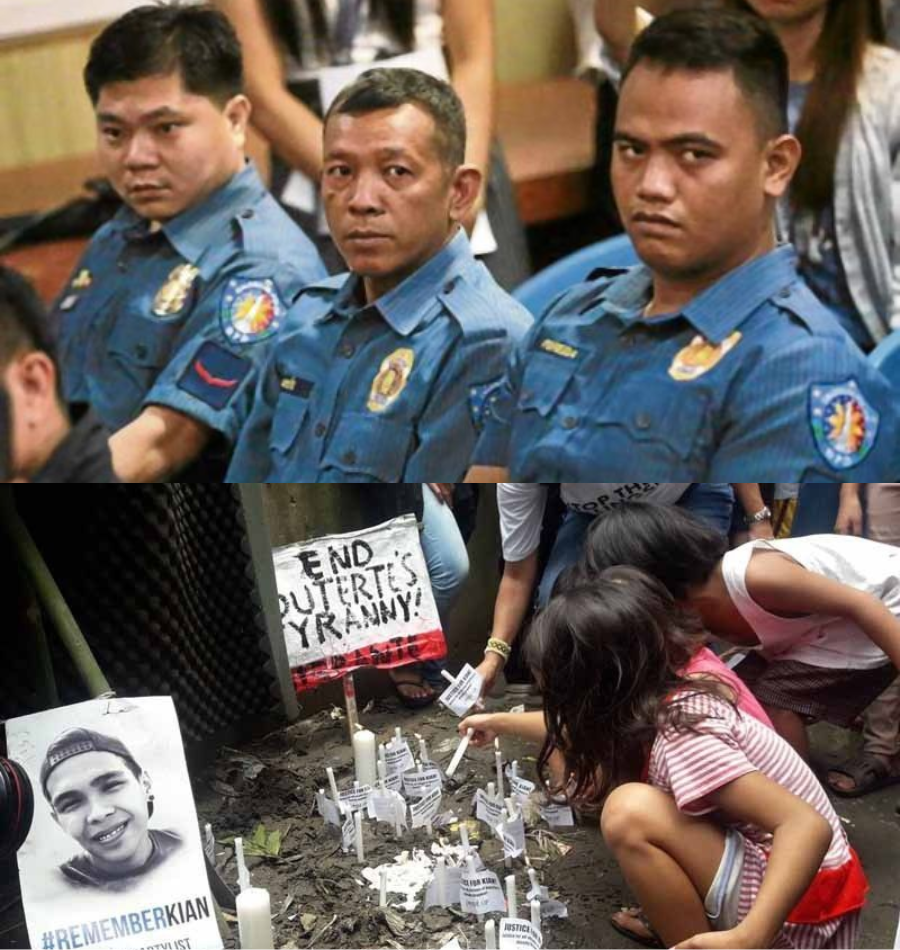
On December 22, 2025, the High Court affirmed the murder conviction of police officers Arnel Oares, Jeremias Pereda, and Jerwin Cruz for the killing of Kian delos Santos, sentencing all three to reclusion perpetua, or up to 40 years of imprisonment.
This ruling leaves no room for reinterpretation, excuses, or revisionist narratives. The Supreme Court declared in unmistakable terms: the killing of Kian delos Santos was an unlawful execution, carried out under the guise of an official operation.
The Night That Changed Everything

On the evening of August 16, 2017, Kian delos Santos was stopped by police officers in Barangay Baesa, Caloocan City, during a security operation conducted in the area.
Kian was a Grade 11 student, a minor, and unarmed.
According to multiple eyewitnesses, the teenager was forcibly detained, struck repeatedly, and heard pleading for mercy. Residents later testified that Kian cried out, begging to be allowed to go home because he had an exam the following day.
Instead of being released or brought to proper authorities, Kian was dragged to a dark, isolated location near a river.
Minutes later, gunshots shattered the silence.
Kian was found dead.
Courts Reject the Official Narrative
From the very beginning, the officers involved claimed that the incident occurred during a lawful police response to alleged criminal activity in the area. They insisted that Kian posed a threat.
But that story unraveled under judicial scrutiny.
In decisions handed down successively by the Regional Trial Court, the Court of Appeals, and now the Supreme Court, judges found that the officers’ version of events was inconsistent, unsupported by evidence, and contradicted by eyewitness testimony and physical findings.
The Supreme Court emphasized that:
Kian was already under police control
He was unable to resist or escape
He was deliberately brought to a secluded area
The killing was executed in a manner that ensured no risk to the perpetrators
These factors, the Court ruled, clearly established treachery, qualifying the crime as murder.
“No Badge Authorizes an Execution”
In its 40-page decision, the Supreme Court delivered one of its strongest statements on the limits of police authority.
The justices categorically rejected the claim that the officers were simply performing their duties, stressing that:
“The lawful performance of duty can never justify the killing of a defenseless civilian, especially a minor.”
The Court further stated that no security operation—under any circumstance—authorizes summary punishment.
The ruling also ordered the convicted officers to pay ₱275,000 in damages to the family of Kian delos Santos.
A Case That Awakened a Nation
Kian’s death sent shockwaves across the country.
Images of a smiling teenager in his school uniform circulated widely, igniting public anger and sorrow. Candlelight vigils were held in cities and provinces. Churches, schools, and civic groups demanded answers.
For many Filipinos, the case came to symbolize what happens when authority goes unchecked and accountability disappears.
Years passed. Appeals were filed. Delays tested the patience of a grieving family.
But the evidence remained.
And now, the verdict is final.
Equal Guilt, Equal Punishment
The Supreme Court upheld the finding that two officers fired the fatal shots, while the third stood guard, ensuring the act could be carried out without interruption.
Under the law, the Court ruled, all three are equally responsible.
The decision reinforces a critical legal principle: participation in an unlawful killing—whether by action or by enabling silence—carries the same criminal weight.
Justice, Though Delayed, Was Not Denied

At memorial gatherings marking the anniversary of Kian’s death, his uncle Randy delos Santos held his nephew’s photograph and spoke words that resonated deeply with the public:
“Justice took time, but it came. Please do not forget Kian.”
For the family, the ruling does not erase their loss—but it affirms that the truth was not buried.
A Turning Point for Law Enforcement Accountability
Legal experts describe the Supreme Court’s affirmation as a landmark ruling—one that sends a clear signal to all members of the security sector.
Authority has limits.
Uniforms do not grant immunity.
Time does not erase responsibility.
The Court made it clear that abuse of power will eventually face judgment, no matter how long it takes.
The End of One Case—And a Question That Remains
As prison doors close behind the three convicted officers, the nation is left with an uncomfortable but necessary question:
If justice was possible for Kian delos Santos—
how many others are still waiting?
Kian did not live long enough to finish school, chase dreams, or grow old. But his name now stands as a permanent reminder that the law, when it finally speaks, must speak for the powerless.
And in this case, the Supreme Court spoke clearly, firmly, and without mercy:
Guilty.