The ASEAN Gauntlet: Philippines Takes Chairmanship Amid South China Sea Stalemate and Regional Crises
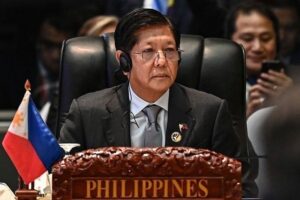
KUALA LUMPUR, Malaysia – The Philippines has formally assumed the mantle of regional leadership. At the conclusion of this year’s ASEAN summit in Kuala Lumpur, President Ferdinand “Bongbong” Marcos Jr. officially accepted the chairmanship of the Association of Southeast Asian Nations (ASEAN) for 2026 from Malaysian Prime Minister Anwar Ibrahim. This highly symbolic handover ceremony places on Manila’s shoulders a daunting set of entrenched regional challenges that defy easy resolution, setting up the Philippines’ year-long stewardship as a crucial test for the bloc’s resilience and effectiveness.
“Leading the ASEAN bloc is an enormous responsibility,” President Marcos told reporters following the ceremony. He tempered this acknowledgment with a hopeful perspective: “But at the same time, it provides us great opportunities.”
For 2026, the Philippines must demonstrate that optimism can endure as it inherits geopolitical flashpoints that have severely tested the organization’s unity and international credibility. Crucially, Manila must lead the charge in trying to finalize a long-sought-after Code of Conduct (COC) aimed at managing mounting tensions in the volatile South China Sea, all while simultaneously navigating its own escalating disputes with Beijing.
I. The Looming Challenge: Finalizing the Code of Conduct
The most visible litmus test for the Philippines’ chairmanship will undoubtedly be the protracted negotiation of the COC between ASEAN and China—an agreement that has frustratingly stalled for nearly two decades.
President Marcos Jr. made it unequivocally clear in Kuala Lumpur that the COC negotiations top his agenda. When pressed by journalists on whether Manila would accept a non-binding agreement, his response revealed a firm, if perhaps politically optimistic, stance: “How do you make a treaty legally-binding? If you sign a treaty, you are expected to be bound by it.”
The inherent political friction lies precisely in that expectation. Beijing and several ASEAN member states have spent years carefully avoiding a commitment to a legally-binding, enforceable document. Fundamental questions remain unresolved, acting as massive roadblocks to progress:
Will the COC contain enforcement mechanisms?
Who exactly will it bind (military, coast guard, fishing fleets)?
What specific actions constitute a violation?
And, most contentiously, which waters will the agreement actually cover?
Ian Chong, a prominent political scientist specializing in Southeast Asian politics at the National University of Singapore, notes that these complex, high-stakes questions “do not lend themselves to quick resolution.” He views ASEAN chairs not as revolutionary fixers, but as “essentially stewards who have to keep the issue moving and incrementally close the gaps between parties.”
The political reality dictates that no member government wants to declare the COC negotiations a failure and shoulder the blame for the potential instability that would follow. Yet, if negotiators rush to meet a perceived 2026 deadline, Chong warns, “the issue about the usefulness or meaningfulness of any agreement may also arise.”
Despite the entrenched difficulties, Marcos maintains a positive outlook. “At heart I’m an optimist,” he affirmed. “We cannot give up.” Marcos even expressed openness to inviting Chinese President Xi Jinping to Manila for a formal signing ceremony, should the COC be concluded in 2026, though he prudently acknowledged that such an invitation would only be extended if “we have made significant progress.”
The Provocateur Paradox
A complication even more significant than the COC talks themselves is the “provocateur problem.” The Philippines must lead these sensitive negotiations while simultaneously being the target of aggressive actions by Beijing in the South China Sea. Furthermore, it must manage internal dynamics where some ASEAN members appear to blame Manila for the mounting tension.
Just a day before the handover, President Marcos directly addressed regional leaders and condemned China’s contentious plan to declare a portion of Scarborough Shoal as a nature reserve. Chinese Premier Li Qiang swiftly countered, asserting that the move complied with Chinese law. Marcos later downplayed his own statement, insisting to reporters he was merely “laying out the facts,” not making “a strong statement.”
However, Chong highlights the regional division: some ASEAN members “like to paint” the Philippines’ firm insistence on its sovereignty claims as “provocative.” These governments, preferring regional stability above all, “like to distance themselves from Manila and its position.” Conversely, a bloc of other ASEAN states quietly supports Manila’s resolute stance against China. This public firmness, Chong argues, “opens space and options for them when managing their own ties and contentious issues with Beijing.”
Marcos acknowledged the need to “redefine” the relationship with China, steering it beyond the singular focus on the maritime dispute. “I would very much like to say… we disagree, we agree to disagree, now let’s do other things,” he said. Chong advises Manila to “continue focusing on the rule of law and its importance,” noting that restraint on major powers is vital for the self-interests of most middle and smaller ASEAN powers.
II. Inherited Crises: Myanmar and Border Frictions
Beyond the immediate crisis in the South China Sea, Marcos inherits deeply entrenched regional problems that show no signs of abating.
Foremost among these is the ongoing crisis in Myanmar. Its military junta remains defiant despite nearly four years of diplomatic isolation following its 2021 coup. ASEAN’s own peace roadmap, the “five-point consensus” adopted in 2021, has proven entirely inadequate to bring the junta to heel. This predicament has left ASEAN immobilized, caught between international pressure for tougher sanctions and its own foundational, yet crippling, principle of non-interference.
The situation will reach an immediate boiling point for the Philippines as the junta has scheduled so-called “sham elections” for December 28, just days before Manila formally takes the chair. ASEAN has debated for years how to respond to the regime’s brutality, yet achieved little consensus. Marcos admitted in Kuala Lumpur that the bloc could not agree on whether to send election observers, noting, “Everyone has a different idea.”
Facing the prospect of leading a divided bloc, Marcos said he would be “calling around” to see if consensus is possible before the polls. While acknowledging that “It would be much preferable if ASEAN moves as one,” he was prepared for division: “If consensus proves impossible, the Philippines will move by itself. We will agree to disagree.”
The Myanmar problem perfectly encapsulates what many critics view as ASEAN’s core systemic weakness: its operation by consensus, which grants any single member the power to effectively veto collective action. While this principle has kept the diverse bloc together for almost six decades, it paralyzes the group when crises demand swift or forceful collective response. In addition, Chong noted, the Philippines will need to manage ongoing Thai-Cambodia border friction, despite a recent arrangement to ease hostilities.
III. Economic Turbulence and Geopolitical Crosscurrents
The third major test for the Philippines involves keeping the ASEAN economic engine steady amidst the swirling economic uncertainties fueled by the ongoing trade war between Washington and Beijing.
In Kuala Lumpur, Chinese Premier Li Qiang made an explicit call for ASEAN countries to “close ranks” against what he characterized as “bullying” and “unreasonable” trade pressure from foreign powers—a clear reference to escalating US economic policies. The summit concluded with the signing of an upgraded ASEAN-China Free Trade Agreement (ACFTA 3.0), a powerful indicator of where many members see their economic future. ASEAN is now officially China’s largest trading partner, with bilateral trade reaching a robust $\text{\$771 billion}$ last year.
Chong emphasizes that Manila must carefully navigate these cross-pressures, arguing the bloc needs to keep “smoothing over the economic uncertainties surrounding the US and PRC while promoting cooperation.” Adding to this complexity are the regional anxieties created by “growing PRC pressure toward Taiwan and friction over the East China Sea,” tensions that could easily spill into Southeast Asia whether ASEAN wishes them to or not.
When confronted with Malaysian Prime Minister Anwar Ibrahim’s warning against “outside interference” in the South China Sea, Marcos affirmed that he “fully agreed” that ASEAN should lead. He then made a critical distinction: though the dispute between Manila and Beijing is bilateral, he argued that this “does not preclude the involvement of ASEAN.” Marcos reasoned that the bloc’s strength lies in its diversity, as it includes countries “that are involved in trade with China, that are politically aligned even with China,” making it “more likely for us to find a way forward.”
Chong concludes that Beijing’s interest in engaging ASEAN is high at a time when it faces heightened competition with Washington and its own domestic economic headwinds. This reality creates a strategic leverage point for Manila as chair, giving it a unique “opportunity to manage ties between ASEAN members and the PRC.” The Philippines’ chairmanship in 2026 will thus be defined by its ability to convert this diplomatic leverage into tangible progress on regional security and unity.