Charting a Sustainable Tomorrow: President Marcos Jr. Arrives in Busan for the 32nd APEC Summit
BUSAN, South Korea – The Republic of the Philippines reaffirmed its profound commitment to multilateral cooperation and sustainable economic growth as President Ferdinand “Bongbong” Marcos Jr. touched down in Busan, South Korea, on Thursday afternoon, marking the start of his participation in the pivotal 32nd Asia-Pacific Economic Cooperation (APEC) Summit.
The presidential aircraft, carrying President Marcos and the high-level Philippine delegation, landed at the Gimhae Air Base precisely at 5:00 p.m. local time, which was 4:00 p.m. in the Philippines. This visit underscores the immense strategic importance Manila places on the APEC forum, a regional economic bloc that is crucial to the Philippines’ trade and investment landscape.
A Pre-Summit Engagement and the Heart of the Agenda
Immediately following his arrival, President Marcos Jr. was scheduled to engage with the vibrant Filipino community residing in South Korea. This traditional pre-summit meeting serves as an opportunity for the President to personally connect with and express gratitude to the overseas Filipino workers and residents, who are recognized as crucial contributors to the nation’s economy and its soft-power diplomacy abroad.
The central agenda for this year’s summit, hosted by the Republic of Korea, revolves around the theme: “Building a Sustainable Tomorrow.” This theme is a direct reflection of South Korea’s overarching commitment to steering the Asia-Pacific region toward a future that is not only robustly economic but also socially and environmentally inclusive. It aligns squarely with the long-term strategic blueprint of the forum, the APEC Putrajaya Vision 2040, which emphasizes the shared necessity of tackling evolving regional challenges while capitalizing on emerging opportunities, particularly in the twin pillars of digitalization and innovation.
The Philippine delegation’s mission is clear: to actively contribute to the discussions on forging interconnected, sustainable, and inclusive growth, ensuring that the benefits of globalization are felt across all strata of society within the APEC economies.
Addressing Persistent Global Headwinds at the CEO Summit
A major highlight of President Marcos’s schedule will be his keynote address at the prestigious APEC CEO Summit. His speech is anticipated to focus on several persistent and pressing global challenges that continue to impede seamless economic integration and growth across the Asia-Pacific.
Among the key issues the President is expected to tackle are:
Regulatory Fragmentation: The necessity of streamlining differing national regulations to create a more predictable and conducive environment for cross-border trade and investment.
Uneven Digital Infrastructure: Highlighting the urgent need to bridge the digital divide, ensuring that all APEC economies possess the necessary infrastructure to participate fully in the rapidly expanding digital economy.
Supply Chain Risks: Discussing strategies for building more resilient, diversified, and sustainable supply chains to withstand future disruptions, whether they stem from geopolitical tensions, natural disasters, or pandemics.
Furthermore, President Marcos Jr. is slated to strongly emphasize the indispensable role of the private sector in turning high-level APEC and ASEAN declarations into tangible, real-world benefits for their respective stakeholders. He is set to underscore that effective public-private partnership is the engine that will translate regional economic blueprints into job creation, poverty reduction, and sustainable development.
Recognizing the Immense Economic Gravity of APEC
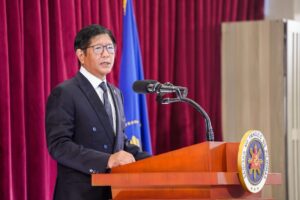
In his pre-departure address delivered in Manila, the Philippine leader articulated the profound economic significance of the APEC region, setting the stage for the country’s proactive participation in the Busan meetings.
“We must recognize the immense economic gravity of the APEC region,” President Marcos stated. He meticulously outlined the compelling statistics that define the bloc’s global clout: “It accounts for nearly 46% of global trade in goods and commercial services and generates roughly 61% of the total global GDP.” These figures undeniably establish APEC as the single most important economic grouping for the Philippines.
He stressed that the timing of the summit is critical, calling it a “critical juncture” defined by a confluence of global pressures. These challenges include:
Evolving and complex geopolitical landscapes.
Ongoing supply chain disruptions and vulnerabilities.
The escalating, existential threats posed by climate change.
The imperative for equitable and truly inclusive economic growth that leaves no nation or community behind.
For the Philippines, a founding member of APEC, the summit is more than just a gathering; it is a fundamental pillar of its foreign economic policy. The vast majority of the Philippines’ economic and commercial transactions worldwide are conducted within the confines of the 21 member economies of APEC. This deep integration is statistically evident: as of 2024, APEC economies account for a staggering 84% of the Philippines’ total global trade. This statistic underscores why the success of APEC’s agenda directly impacts the daily lives and long-term prosperity of the Filipino people.
The Bilateral Significance with South Korea

The choice of South Korea as the host economy adds a significant bilateral layer to the President’s visit. The Republic of Korea maintains a robust and increasingly vital economic partnership with the Philippines. In 2024 alone, South Korea cemented its position as the Philippines’ fifth major export market and its fourth-largest import supplier. The APEC Summit provides an excellent platform for Marcos Jr. to hold crucial bilateral meetings, potentially unlocking new avenues for trade, investment, technology transfer, and greater people-to-people exchange between the two nations.
Looking Ahead to 2026 and Beyond
The discussions in Busan are expected to lay the groundwork for a more resilient and integrated Asia-Pacific economy moving into 2026. The Philippines, through its participation, aims to champion initiatives that support micro, small, and medium-sized enterprises (MSMEs), empower women in the economy, and foster greater regional connectivity. The delegation is optimistic that the engagement will attract further foreign direct investment into the Philippines, helping the nation navigate current economic headwinds and build a path toward sustained national development. As President Marcos Jr. articulated, the goal is to reduce barriers—be they regulatory, infrastructural, or logistical—to ensure that the full potential of the APEC framework is realized for the benefit of every Filipino.
The 32nd APEC Summit is set to be a defining moment for the Asia-Pacific region, and the presence of President Marcos Jr. signifies the Philippines’ steadfast commitment to being an active, constructive, and forward-looking partner in the global pursuit of a sustainable and prosperous future.